Agentic AI 101: When AI Stops Answering and Starts Doing
Have you ever found yourself in that familiar college scenario: you have a mountain of research papers to read, a presentation to design, and a calendar that looks like a chaotic abstract painting? You turn to your favorite Generative AI tool (let’s call it ‘Gen AI’) and say, “Help me write my presentation outline.”
It spits out a solid five points, you copy-paste it into a document, and you feel like a genius for about five minutes. But then the reality sets in: you still have to read those papers, you still have to design the slides, and you still have to manage your team’s schedule.
This is the limitation of the current AI boom: it generates content, but it doesn’t do the work.
That is all about to change. We are transitioning from the age of Gen AI to the age of Agentic AI.
Generative vs. Agentic: The Great Shift
To understand Agentic AI, we first need to understand its predecessor.
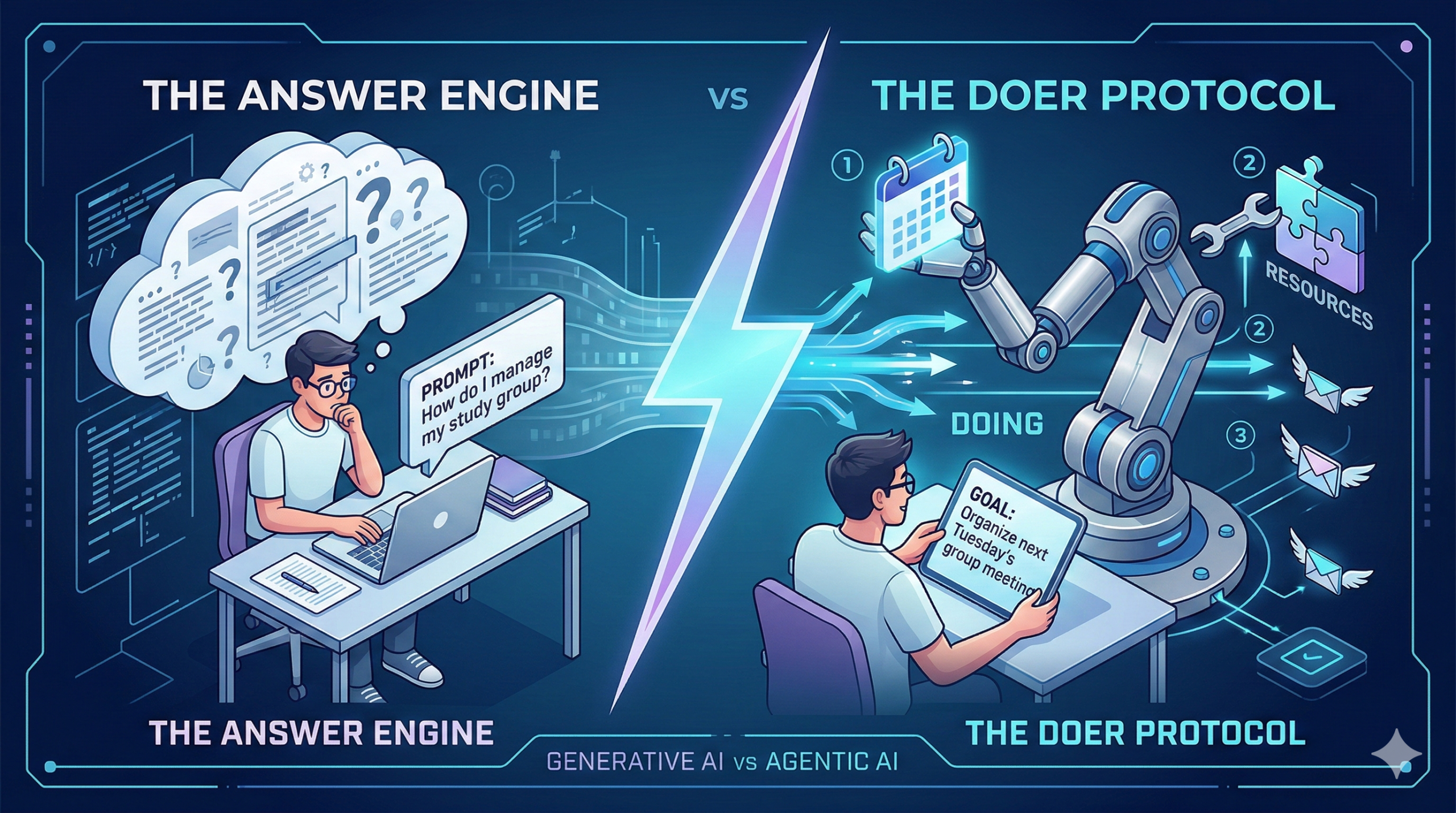
Generative AI is a creator. You give it a prompt, and it produces an output—be it text, code, an image, or a video. It is a one-way street: you ask, it provides. It cannot interact with the world outside its training data or the small playground its developers provided.
Agentic AI (or simply, an “Agent”) is a doer. It is an autonomous system that can perceive its environment, formulate a multi-step plan, and take specific actions to achieve a complex goal. It doesn’t just respond to prompts; it executes tasks.
Think of it this way:
- Gen AI: You ask, “Write an email draft asking for a meeting with my professor.”
- Agentic AI: You say, “Get me a 15-minute meeting with Professor Davis sometime next Tuesday to discuss my capstone topic.”
The Agentic AI then opens your calendar, opens the university directory to find Davis’s availability (or his TA’s), finds a common opening, creates a tentative calendar invitation, drafts the introductory email, and presents the entire package for your final approval.
Gen AI creates. Agentic AI acts.
What Makes an AI “Agentic”?
To move beyond the ‘answering machine’ paradigm, Agentic systems integrate several core capabilities that traditional LLMs lack:
1. Tool Use (or “Functional Competence”)
This is the single most defining characteristic. Agentic AI can utilize tools. It is granted access to software APIs, databases, browsers, calculators, and calendars. It can call functions. If it needs to calculate an advanced statistical regression, it won’t guess the code; it will open a code interpreter (like Python), write the script, run the data, and report the results.
2. Planning and Memory
A true Agent doesn’t just react in the moment. When given a complex goal (“Plan my spring break trip for $500”), it breaks that massive objective into manageable sub-tasks: search flights, search hostels, check reviews, build an itinerary. It executes these steps sequentially, maintaining a “state” (memory) of its findings, and adjusting its plan if it hits a roadblock (like a sold-out hostel).
3. Autonomy and Persistence
Gen AI sessions reset after every prompt. An agentic process is persistent. You can assign an Agent a multi-day task. For example: “For the next week, monitor the discussion forum for this class. Summarize any key insights or upcoming deadlines every evening at 8 PM.” The agent will keep running, independently monitoring the environment, and reporting back on schedule.
Why College Students Should Care
The transition to Agentic AI isn’t just cool tech trivia; it will reshape how you manage your academic life, conduct research, and even apply for internships. Here’s why you should start looking for Agentic tools now:
1. Deep Research, Automated
Forget skimming abstract databases for hours. An agentic system can take your thesis topic, autonomously navigate academic search engines, download relevant papers, identify key findings across all of them, and produce a literature review with citations in a fraction of the time. It doesn’t just search; it reads, synthesizes, and outputs.
2. Project Management 2.0
As projects get bigger, management gets harder. An Agent can monitor your group project’s shared drive. You could configure it to automatically check off completed tasks when files are uploaded, send a gentle Slack reminder to teammates who are falling behind, and generate a burndown chart for your TA.
3. Hyper-Personalized Career Prep
Imagine an agentic career counselor. You upload your resume and LinkedIn URL. It scans job boards for positions that fit your criteria, identifies key skill gaps, suggests specific online courses to take, and—critically—can use APIs to automatically submit initial ‘Easy Apply’ applications to ten targeted companies, leaving you free to focus on interview prep.
The New Rules: Verification and Goals
The rise of Agentic AI requires a shift in our skills as users. While Gen AI requires Prompt Engineering (knowing how to ask the right question), Agentic AI requires Goal Specification and Verification.
Because an agent is autonomous, it can make autonomous mistakes. It might book a non-refundable flight that isn’t optimal, or it might accidentally overwrite a critical research document because you gave it a vague command.
The students who will thrive in the age of Agentic AI won’t be the ones who can write the longest prompts. They will be the ones who can define precise, constrained goals (“Find flights under $300, leaving after 4 PM”) and who know how to rigorously verify the Agent’s outputs and actions.
The era of AI answering our questions is winding down. The era of AI executing our intentions has begun. Are you ready to move from “Ask” to “Do”?