Agentic AI vs Generative AI
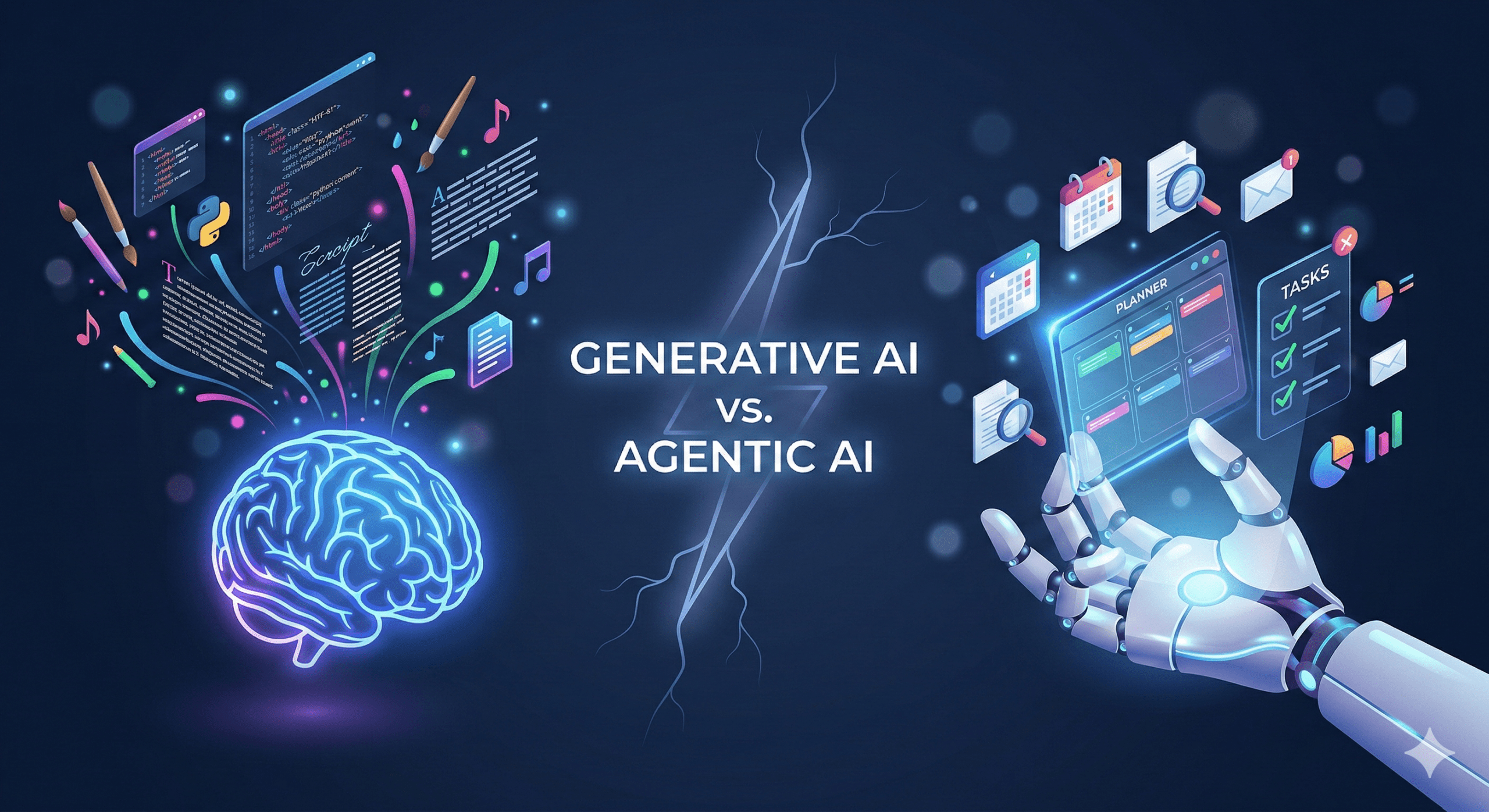
AI has become the “new calculator” of the internet age—everyone uses it, but not everyone understands what’s happening under the hood. Two terms you’ll hear a lot are Generative AI and Agentic AI. They’re related, but they’re not the same thing. Think of it like this:
- Generative AI creates content.
- Agentic AI gets things done.
Let’s break it down in a way that actually sticks.
What Is Generative AI?
Generative AI is AI that produces new content based on patterns it learned from training data. When you type a prompt, it generates a response—text, images, code, audio, video, and more.
What it’s great at
- Writing essays, summaries, and explanations
- Generating code snippets
- Creating images or designs
- Brainstorming ideas (project topics, startup concepts, captions)
- Translating and rewriting content
A simple mental model
Generative AI is like a super-powered autocomplete.
It predicts what comes next—often incredibly well.
College example
You ask:
“Explain photosynthesis in simple terms for a presentation.”
It replies with a clean explanation you can use immediately.
What Is Agentic AI?
Agentic AI (or “AI agents”) refers to AI systems that can plan, take actions, and complete multi-step tasks, often using tools like browsers, calendars, APIs, code execution, or databases.
Instead of only answering, an agent can:
- Understand a goal
- Break it into steps
- Act on those steps
- Check progress
- Adjust and continue until done
What it’s great at
- Researching across multiple sources and summarizing findings
- Planning a workflow (study schedule, project timeline)
- Executing tasks (booking, emailing drafts, generating files, running scripts)
- Monitoring things (price changes, new papers, system health checks)
- Doing repetitive work reliably (forms, reports, data cleanup)
A simple mental model
Agentic AI is like an intern who can use apps and tools.
Not just talk—actually operate.
College example
You ask:
“Build me a 2-week study plan for finals based on my courses and time availability, then create a checklist and reminders.”
An agent could generate the plan, format it, and (in some setups) push it into your calendar.
The Key Differences That Matter
1) Output vs Outcome
- Generative AI gives you an output (text/image/code).
- Agentic AI aims for an outcome (task completed).
2) Single-step vs Multi-step
- Generative AI: Usually responds in one go.
- Agentic AI: Works through a sequence of steps.
3) Passive vs Active
- Generative AI: “Here’s the answer.”
- Agentic AI: “Here’s the plan—now I’m executing it.”
4) Tool Use
- Generative AI: Often limited to generating content.
- Agentic AI: Often includes tool access (search, files, scripts, APIs).
A Quick Scenario: “Help Me With My Group Project”
If you use Generative AI
You might ask:
- “Give me 10 ideas for a capstone project.”
- “Write a problem statement.”
- “Create a presentation outline.”
- “Generate sample code.”
It helps you create pieces of the project faster.
If you use Agentic AI
You might ask:
- “Research 10 recent papers on topic X, extract key findings, propose a project idea, assign tasks to group members, and draft a timeline.”
It helps you drive the whole project forward—end to end.
Where Agentic AI Can Go Wrong (And Why You Should Care)
Agentic systems are powerful, but they introduce new risks because they can act.
Common issues:
- Tool mistakes: A wrong click or wrong file can cause real problems.
- Bad assumptions: If the goal is vague, the agent may confidently do the wrong thing.
- Security/privacy: Giving an agent access to accounts or files increases exposure.
- “Looks done” syndrome: It may produce something polished that still needs verification.
Best practice for students:
Use Agentic AI like you’d use a smart assistant: supervise it, review its work, and verify sources.
How This Changes Skills You Should Build in College
If you rely on Generative AI…
You’ll get the most value by improving:
- Prompting clearly
- Editing and fact-checking
- Asking for examples and step-by-step logic
- Using it as a tutor, not a cheat engine
If you use Agentic AI…
You’ll also want skills in:
- Defining goals and constraints precisely
- Evaluating outputs quickly
- Building workflows (“Do X, then Y, then validate Z”)
- Understanding basics of data privacy and security
Quick Cheat Sheet
Use Generative AI when you need:
- Drafts, explanations, summaries
- Code ideas or templates
- Creative content and brainstorming
Use Agentic AI when you need:
- Research + synthesis across sources
- Multi-step planning and execution
- Automation and repeated tasks
Final Take
Generative AI is the content engine.
Agentic AI is the task engine.
If you’re a college student, learning the difference helps you choose the right tool for the job—and use it responsibly. In the near future, the students who stand out won’t be the ones who “use AI,” but the ones who can direct AI like a project manager: clear goals, good constraints, and strong verification.